Indian Furniture Wood Comparison Tool
Find your ideal furniture wood
Compare Indian woods based on your priorities for strength, cost, and durability. Select what matters most to you.
Strength
How important is raw strength and density?
Cost
How important is affordability?
Durability
How important is long-term resistance?
Workability
How important is ease of craftsmanship?
Your Recommended Wood
Select your priorities and click "Find Best Match" to see your recommendation
When you’re building furniture in India, you don’t just pick wood because it looks nice. You pick it because it has to last-through monsoons, heat, termites, and decades of use. The strongest wood isn’t always the most expensive, and the most popular isn’t always the most durable. So which wood actually holds up the best across India’s varied climates and heavy usage?
Teak: The Classic Choice with Real Strength
Teak (Tectona grandis) is the wood most people think of when they hear "strong Indian wood." It’s been used in royal furniture, temple carvings, and shipbuilding for centuries. Why? It has a natural oil content that repels water, resists rot, and keeps insects away. That’s not marketing-it’s science. Teak’s density averages 650-750 kg/m³, making it one of the densest hardwoods native to India. In real-world terms, that means a teak dining table can survive 30+ years of daily use without warping or cracking, even in humid coastal cities like Mumbai or Chennai.
But teak isn’t perfect. It’s expensive. A cubic foot of graded teak can cost ₹2,500-₹4,000. It also grows slowly, and illegal logging has made certified teak harder to find. If you’re a small furniture maker, you might not be able to afford it for every piece. But if you’re making high-end pieces meant to last generations, teak still wins.
Sheesham (Indian Rosewood): The Balanced Powerhouse
If teak is the heavyweight champion, sheesham (Dalbergia sissoo) is the all-rounder. It’s widely available across Uttar Pradesh, Punjab, Haryana, and Madhya Pradesh. Its density is around 600-700 kg/m³-close to teak, but more affordable. Sheesham has a beautiful grain pattern, takes polish well, and holds screws and joints tightly. Unlike teak, it doesn’t need constant oiling to stay stable.
Manufacturers in Moradabad and Ludhiana use sheesham for everything from beds and wardrobes to office desks. It’s the go-to for mid-range furniture that needs to be sturdy without breaking the bank. A study by the Forest Research Institute in Dehradun found that sheesham furniture lasted an average of 22 years in households with moderate use. That’s longer than most engineered wood products.
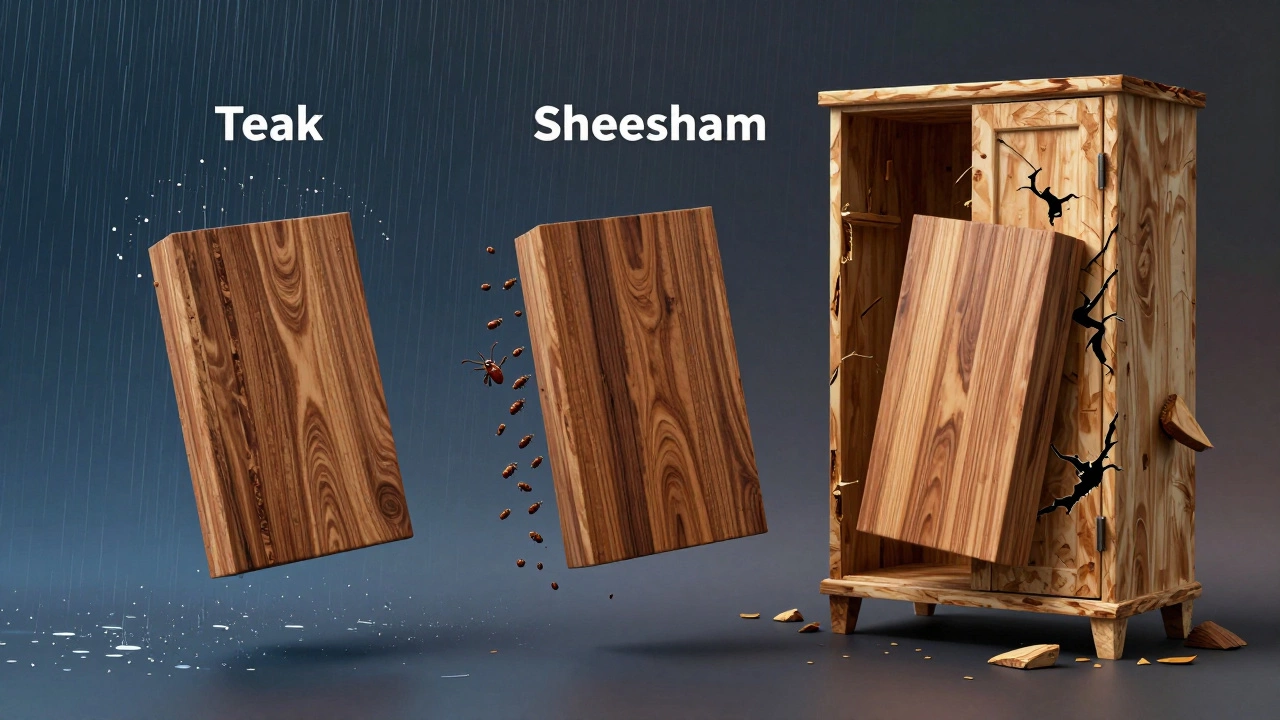
One downside? Sheesham can be prone to insect attack if not properly dried. Reputable manufacturers kiln-dry it to below 12% moisture content. If you see a sheesham piece that feels light or has tiny holes, it’s not been treated right.
Sal Wood: The Underdog That Endures
Sal (Shorea robusta) grows in the forests of Jharkhand, Odisha, Chhattisgarh, and parts of West Bengal. It’s not glamorous. It doesn’t have the rich color of teak or the swirl of sheesham. But it’s tough. Sal has a density of 750-850 kg/m³-higher than teak. It’s used in railway sleepers, bridge beams, and temple pillars across India because it doesn’t bend, split, or rot easily.
For furniture? It’s rare. Why? It’s hard to work with. Sal is so dense that it dulls tools fast. It’s also heavy-so heavy that moving a sal wood cabinet requires two people. But if you’re making outdoor furniture or pieces for industrial use, sal is unbeatable. Some makers in Bhubaneswar use it for outdoor benches and garden tables because it survives rain and sun without coatings.
Indian Maple: The Hidden Gem
Indian maple (Acer spp.) isn’t as famous as teak or sheesham, but it’s gaining traction among modern furniture makers. Found in the Himalayan foothills, it’s lighter than teak but still dense enough at 650-700 kg/m³. It’s easy to carve, takes stains evenly, and has a clean, pale look that fits contemporary designs.
What makes it strong isn’t just density-it’s stability. Indian maple doesn’t expand or contract much with humidity changes. That’s why it’s becoming popular for modular furniture and kitchen cabinets in cities like Delhi and Bangalore, where indoor climate control isn’t always perfect. A 2023 survey by the Indian Woodworking Association found that 42% of new furniture startups in urban centers chose Indian maple for its balance of strength, workability, and cost.
Why Not Plywood or MDF?
You’ll see a lot of "solid wood" furniture made from plywood or MDF. But here’s the truth: those aren’t solid wood. Plywood is layers of thin wood glued together. MDF is sawdust and glue pressed into shape. They’re cheaper and easier to shape, but they don’t last.
A 2022 test by the National Institute of Wood Science in Kolkata compared 10-year-old furniture made from sheesham, teak, and MDF. The MDF pieces showed visible swelling at the edges, loose joints, and crumbling screw holes. The solid wood pieces? They had scratches, yes-but the structure was intact.
If you’re buying furniture for a home that will be lived in for decades, skip the engineered woods. They’re fine for temporary setups or low-use rooms, but they’re not built for strength.
What About Bamboo?
Bamboo is everywhere in India. It’s fast-growing, eco-friendly, and used in flooring and decor. But is it strong enough for heavy furniture? Technically, yes-bamboo has a tensile strength higher than steel per unit weight. But it’s not the same as solid hardwood.
Bamboo furniture works well for chairs, side tables, and shelves. But for beds, wardrobes, or dining sets that need to hold weight over time? It’s risky. Bamboo can split under heavy load, especially if it’s not treated with borax or heat. Most bamboo furniture in India is imported from Southeast Asia and treated poorly. Unless you know the maker and their process, it’s not the strongest choice.
How to Tell Real Strong Wood from Fake
Here’s how to spot real hardwood versus fake:
- Check the weight. Real teak or sheesham feels heavy for its size. If it feels light, it’s probably veneer or MDF.
- Look at the end grain. Solid wood shows natural grain lines running through. Plywood shows layers.
- Test the finish. Scratch a hidden spot. Real wood will show the same color underneath. Laminate or veneer will reveal a different color or plastic layer.
- Ask for certification. Look for FSC or ISI marks. Reputable manufacturers display them.
Don’t trust "solid wood" labels without proof. Many sellers use the term loosely.
Final Verdict: Which Wood Is Truly Strongest?
For pure strength and longevity? Sal wood wins. It’s densest, most rot-resistant, and toughest under stress.
For balance of strength, beauty, and availability? Sheesham is the smart pick for most Indian homes.
For luxury, weather resistance, and heritage value? Teak still leads.
There’s no single "best" wood for every job. But if you’re a furniture maker in India, you need to know the difference. Don’t choose based on price alone. Choose based on how the wood will perform in real life-in your customer’s home, over years, through heat and humidity.
The strongest wood isn’t just about hardness. It’s about resilience. And in India, that means choosing wood that doesn’t just survive-it thrives.
Is teak the strongest wood in India?
Teak is one of the strongest and most durable woods in India, but it’s not the absolute strongest. Sal wood has a higher density and better resistance to stress and rot. Teak’s advantage is its natural oils and workability, not raw strength.
What wood lasts the longest in Indian homes?
Sheesham and teak last the longest in typical Indian households. Both resist termites, handle humidity well, and maintain structural integrity for 20-30 years with basic care. Sal wood lasts even longer but is rarely used in home furniture due to its weight and hardness.
Is Indian maple a good alternative to teak?
Yes, especially for modern furniture. Indian maple is slightly less dense than teak but much easier to work with and more stable in changing climates. It’s ideal for indoor pieces like cabinets and beds where appearance and stability matter more than extreme toughness.
Why is sheesham so popular among Indian furniture makers?
Sheesham is popular because it strikes the perfect balance: it’s strong, affordable, widely available across North India, takes polish beautifully, and holds joints securely. It’s the go-to for mid-range furniture that needs to be durable without the premium price of teak.
Can I use bamboo for heavy furniture like beds?
Bamboo can be used for beds if it’s properly treated and reinforced with metal or hardwood frames. But untreated or poorly made bamboo furniture tends to flex, split, or sag over time. For heavy, long-term use, solid hardwood like sheesham or teak is far more reliable.
If you’re sourcing wood for furniture in India, don’t just ask what’s popular. Ask what’s proven. Test samples. Ask for certifications. Visit the mill if you can. The strongest wood isn’t always the flashiest-but it’s the one your customers will still be using in 20 years.