
Small Scale Production Pricing Calculator
Production Parameters
Cost Analysis & Pricing Strategy
Enter your production details to calculate costs and optimal pricing strategies.
Big factories hum with the rhythm of massive assembly lines. Thousands of identical units roll out every hour. But have you ever wondered how that artisanal soap in your bathroom or the custom coffee grinder on your shelf actually got made? It didn’t come off a conveyor belt moving at lightning speed. It came from small scale production, which is a manufacturing approach focused on limited quantities, high customization, and flexible processes rather than mass volume.
If you are looking to start a business, pivot an existing one, or simply understand where your niche products come from, knowing the mechanics of this process is crucial. Unlike mass production, which chases economies of scale, small scale production chases relevance and quality. The entire workflow changes when you stop thinking about millions of units and start thinking about hundreds or thousands.
The Planning Phase: Designing for Flexibility
Before a single screw is tightened or a drop of ink is spilled, the work begins with planning. In large-scale manufacturing, planning is about minimizing variance. In small scale operations, planning is about maximizing adaptability. You cannot afford expensive, dedicated machinery that only does one thing. If the market shifts next month, that machine becomes a paperweight.
Instead, the focus here is on product design that allows for modular components and general-purpose tooling. Engineers and designers look for parts that can be sourced locally or produced using standard tools. They map out the Bill of Materials (BOM) not just for cost, but for availability. Can you get these raw materials in small quantities? Do you need a minimum order quantity (MOQ) of 10,000 units for the packaging?
This stage also involves defining the "batch size." Are you making 50 units? 500? This number dictates everything downstream. It determines how much floor space you need, how many workers you hire, and what kind of inventory management system you use. A common mistake beginners make is trying to plan for growth too early. Stick to the current demand. Over-planning leads to wasted capital on equipment you don't need yet.
Sourcing Raw Materials: The MOQ Challenge
One of the biggest hurdles in small scale manufacturing is sourcing. Big manufacturers buy steel by the tonne or plastic pellets by the container load. They get rock-bottom prices because they move volume. You, however, are buying in kilograms or liters. Suppliers often hesitate to deal with small orders because the administrative cost of processing the invoice is almost the same as for a large order.
To solve this, small producers often turn to specialized distributors or join buying cooperatives. Another strategy is vertical integration-making some of your own components instead of buying them. For example, if you are building furniture, you might cut your own wood veneers rather than buying pre-cut sheets, even if it takes longer. It gives you control over quality and eliminates the supplier's markup.
You also need to consider lead times. In mass production, materials arrive just-in-time (JIT). In small scale production, JIT can be risky. If your sole supplier runs out, you are stuck. Many small manufacturers keep a safety stock of critical raw materials. It ties up cash, yes, but it keeps the lights on when supply chains hiccup.
Setting Up the Workspace: General-Purpose Tools
Your workshop looks different from a factory floor. There are no endless rows of robotic arms. Instead, you see versatile machines. A CNC milling machine can cut aluminum, brass, or wood depending on the tool bit inserted. A sewing machine can handle denim or silk with a simple adjustment. This versatility is the heart of general-purpose equipment, which is machinery designed to perform a wide variety of tasks rather than a single specialized function.
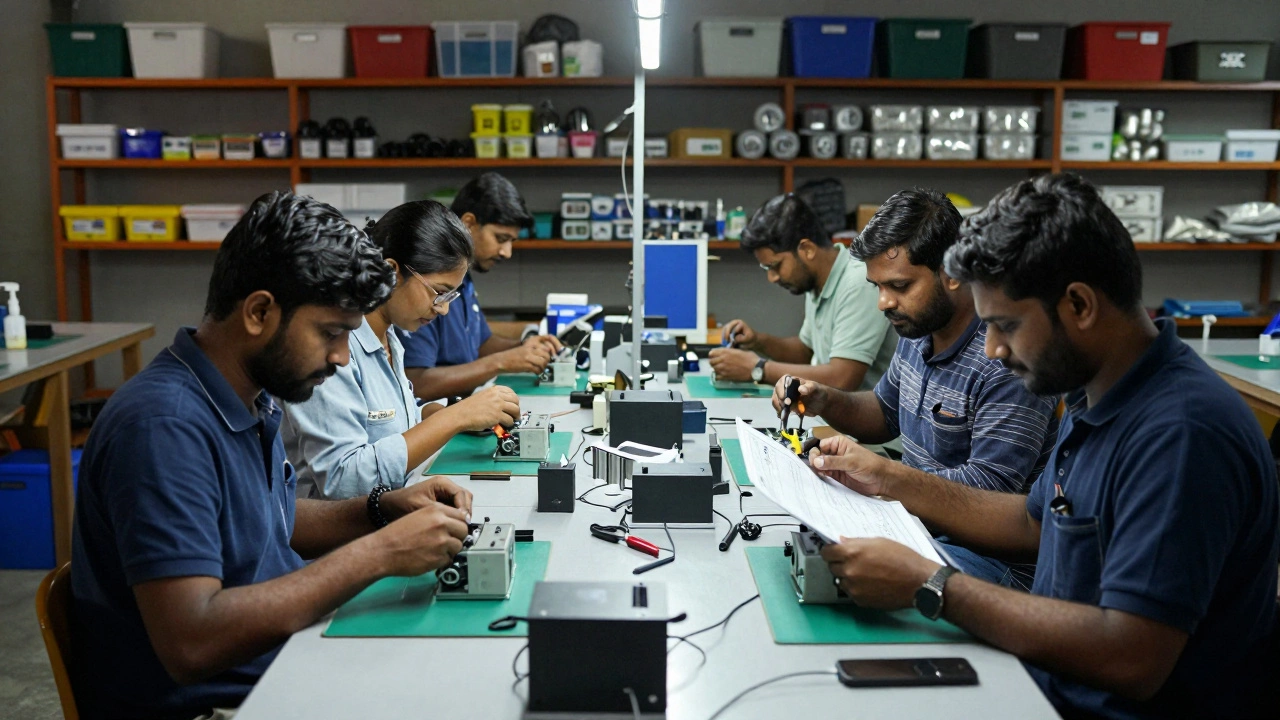
Layout matters immensely. In a big plant, the layout follows the product flow linearly. In a small shop, you might arrange tools by function (all cutting tools together, all assembly stations together). This reduces the time workers spend walking between stations. Since labor is a significant cost in small scale production, efficiency in movement translates directly to profit.
Don't underestimate the power of simple jigs and fixtures. These are custom-made guides that hold parts in place while you work. They ensure consistency without needing expensive automation. A well-made jig can allow a novice worker to produce parts that meet tight tolerances, effectively raising the skill ceiling of your entire team.
The Production Process: Batch Processing vs. Job Shops
How do you actually make the stuff? There are two main models. The first is batch processing, where groups of identical items are produced together before moving to the next step. Imagine baking cookies. You mix a batch of dough, bake them all at once, then decorate them all at once. This is efficient for medium volumes (100-1,000 units). It minimizes setup time because you change settings once per batch.
The second model is the job shop approach. Here, each item moves through the entire process individually. One person cuts, assembles, tests, and packs a single unit before starting the next. This is ideal for highly customized products, like bespoke suits or prototype electronics. It offers maximum flexibility but lower throughput.
In practice, most small manufacturers blend these approaches. They might batch-produce generic components (like screws or casings) and then assemble them into unique final products using a job shop method. This hybrid approach balances efficiency with customization.
Quality Control: Human Eyes and Hands
In mass production, quality control (QC) is automated. Sensors detect defects faster than humans ever could. In small scale production, QC is deeply human. Your workers are not just operators; they are inspectors. Because batches are smaller, it is feasible-and necessary-to check every single unit.
This hands-on approach has a major advantage: traceability. If a customer reports a defect, you can often pinpoint exactly which batch it came from, who worked on it, and potentially why it failed. This level of detail helps you improve processes rapidly. You don't wait for quarterly reviews; you fix issues today.
However, human inspection is subjective. To mitigate this, small manufacturers create detailed checklists and visual standards. "Good" and "bad" samples are displayed prominently at each workstation. This aligns everyone’s perception of quality. Regular calibration of measuring tools is also non-negotiable. A caliper that is off by a millimeter can ruin an entire batch of precision parts.

Assembly and Customization: Adding Value
This is where small scale production shines. Mass production struggles with variation. Every time a car factory adds a new color option, it costs millions to retool. In your workshop, adding a new feature is a conversation away. You can offer personalized engraving, custom colors, or modular upgrades without disrupting the whole line.
Assembly often requires skilled labor. While robots are getting cheaper, they still struggle with delicate tasks like wiring complex electronics or stitching irregular fabrics. Humans excel at dexterity and problem-solving. When a part doesn't fit quite right, a human adjusts. A robot jams. This flexibility allows small manufacturers to iterate designs on the fly. You can tweak a prototype during assembly based on real-world feedback.
Value-added services are key here. Offering personalization turns a commodity into a premium product. Customers pay more for items that feel made for them. This higher margin helps offset the higher per-unit labor costs inherent in small scale operations.
Packaging and Logistics: The Last Mile
Once the product is built, it needs to reach the customer. Packaging in small scale production serves two purposes: protection and branding. Since you aren't shipping pallets of identical boxes, you have the freedom to design unboxing experiences that delight customers. Think of Apple’s packaging-it’s an extension of the brand.
Logistics are trickier. You don't have the leverage to negotiate bulk shipping rates with FedEx or DHL. To combat this, many small manufacturers use third-party logistics (3PL) providers who aggregate shipments from multiple small businesses. Alternatively, selling direct-to-consumer (DTC) via e-commerce platforms allows you to optimize packaging sizes, reducing dimensional weight charges.
Inventory management remains critical. You need to track finished goods carefully. Unlike mass producers who sell to distributors, you likely sell directly to end-users. This means your warehouse is also your fulfillment center. Efficient picking and packing processes are essential to keep shipping costs down and delivery times fast.
| Feature | Small Scale Production | Mass Production |
|---|---|---|
| Volume | Low to Medium (Units to Thousands) | High (Millions+) |
| Customization | High (Bespoke options available) | Low (Standardized only) |
| Equipment | General-purpose, flexible | Dedicated, specialized |
| Labor Skill | Skilled, multi-tasking | Semi-skilled, repetitive tasks |
| Cost Per Unit | Higher | Lower |
| Time to Market | Fast (Agile iterations) | Slow (Long setup cycles) |
Financial Realities: Margins and Cash Flow
Let’s talk money. Small scale production has higher variable costs per unit. You pay more for materials, labor, and overhead relative to output. So how do you survive? You charge more. Your value proposition isn't price; it's uniqueness, quality, and story.
Cash flow is the lifeblood. Because you buy materials upfront and may sell on credit terms, you need working capital. Many small manufacturers fail not because their product is bad, but because they run out of cash waiting for payments. Invoice promptly. Offer discounts for early payment. Keep inventory lean to free up cash.
Pricing strategies must reflect true costs. Don't just guess. Calculate material costs, labor hours, overhead allocation, and desired profit margin. Use software tools to automate this calculation. Underpricing is a silent killer in small business. Ensure your price covers all hidden costs, including returns and warranty claims.
Is small scale production profitable?
Yes, but not through volume. Profitability comes from higher margins on specialized, high-quality, or customized products. You compete on value, not price. Successful small manufacturers often build strong brand loyalty that allows them to command premium prices.
What is the biggest challenge in small scale manufacturing?
Sourcing materials efficiently is often the hardest part. Minimum Order Quantities (MOQs) from suppliers can tie up cash and create waste. Finding suppliers willing to work with small batches or investing in vertical integration to make your own components are common solutions.
Can small scale production scale up?
Absolutely. Many large companies started small. As demand grows, you can gradually introduce semi-automated tools, expand your team, and optimize workflows. The key is to maintain flexibility while improving efficiency, avoiding the trap of over-investing in rigid infrastructure too early.
Do I need a lot of space for small scale production?
Not necessarily. Small scale operations are known for their agility and compact footprints. A well-organized garage or small workshop can suffice for many products. Efficient layout and lean inventory practices help maximize limited space.
How does quality control differ in small scale production?
QC is more hands-on and human-centric. Instead of relying solely on automated sensors, workers inspect each item. This allows for immediate correction of errors and better traceability. However, it requires trained staff and clear quality standards to ensure consistency.